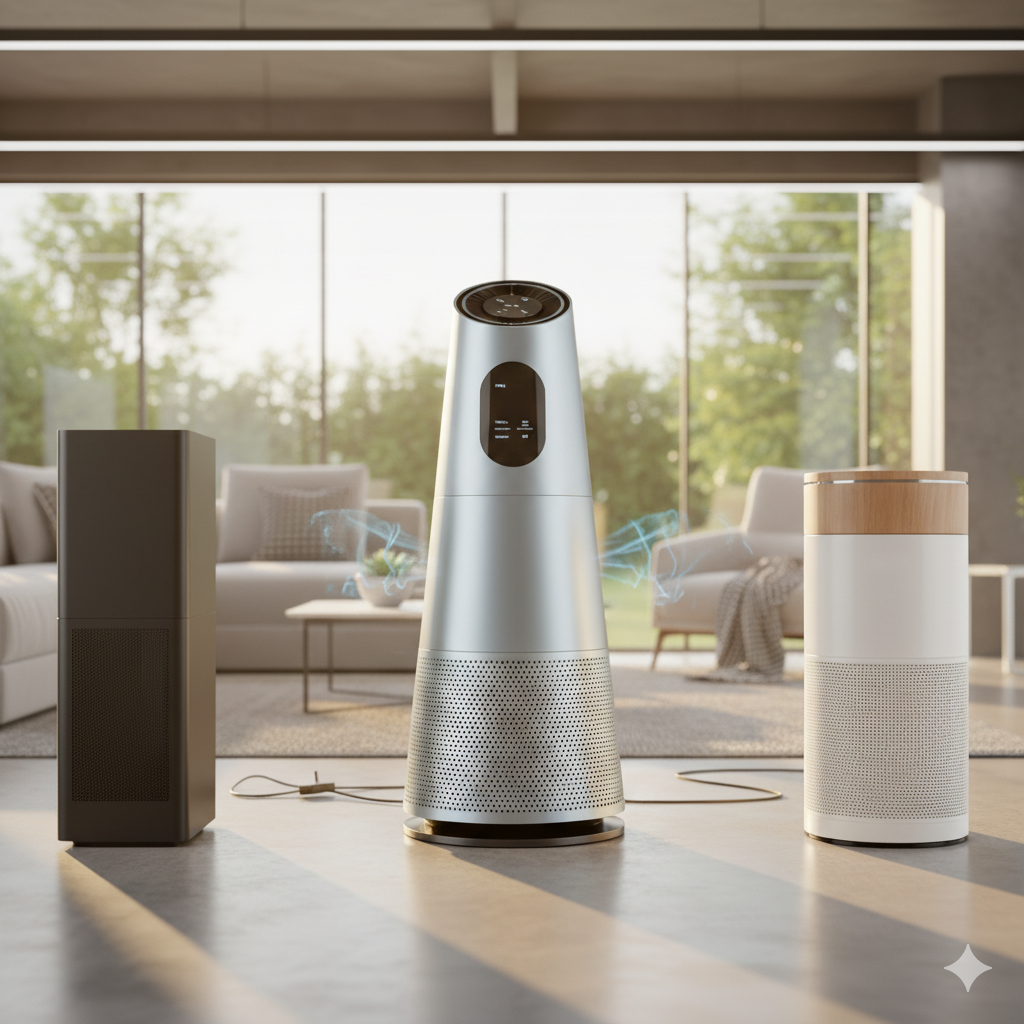
Clearing a big space fast? We vetted high-capacity air purifiers on Amazon and picked five standouts for large rooms and open-plan homes. These models prioritize strong airflow and efficient filtration (true HEPA or equivalent multi-stage systems), sensible filter replacement schedules, and dependable build quality.
You’ll see options that suit different priorities: quiet operation for bedrooms, app control and sensors for set-and-forget use, value workhorses for living areas, and ultra-high output units when you want the most air moved with the fewest machines.
If you’re sizing up, remember that CADR and air changes per hour (ACH) matter more than marketing “square-footage” alone—aim for at least 4–5 air changes per hour in the room you actually use, and consider two units if your space is irregular or multi-room. Below are our favorites that balance performance, noise, and upkeep, with links to Amazon for easy shopping and filter resupplies.
Quick Picks
Top Pick
Levoit Core 600S
Big-room performance with smart control and an efficient, well-sealed filter stack; excellent day-to-day usability.
Runner-Up:
Coway Airmega 400
Dual-intake design with auto modes and a proven track record for large living spaces and open layouts.
Best Value:
Honeywell HPA5300B
A no-nonsense large-room workhorse with easy controls and widely available replacement filters.
Best for Super-Large Rooms:
Medify MA-112
Ultra-high output, H13 HEPA filtration, and a cabinet sized for serious airflow in big, busy areas.
Low-Maintenance & Quiet:
Blueair Blue Pure 211+ Auto
Simple one-button operation with a high-flow filter cartridge and a calm sound profile at everyday speeds.
How We Chose
We selected purifiers using these criteria:
- Airflow & efficiency: High CADR/CFM for rapid air changes, with sealed multi-stage filtration.
- Real-world usability: Noise at typical speeds, auto/smart modes, filter availability, and upkeep cost.
- Build & safety: Solid housings, reputable brands, and clear documentation for filters and maintenance.
- Availability: Readily stocked on Amazon U.S. with strong buyer feedback and U.S. support.
Head-to-Head Comparison
| Product | Filtration | Smart / Auto | Noise Profile | Notable Strength | Best For |
|---|---|---|---|---|---|
| Levoit Core 600S | Pre-filter + HEPA + carbon | App + auto | Quiet at low/auto | Strong performance + app control | Large rooms needing smart control |
| Coway Airmega 400 | Dual intake, HEPA + carbon | Auto modes | Balanced | Reliable large-space coverage | Open-plan living areas |
| Honeywell HPA5300B | HEPA + carbon pre-filters | Auto modes | Audible on “Turbo” | Value large-room workhorse | Budget high-flow needs |
| Medify MA-112 | H13 HEPA + carbon | Auto (select versions) | Moves a lot of air | Ultra-high capacity | Super-large rooms |
| Blueair Blue Pure 211+ Auto | HEPASilent™ + carbon | Auto | Very calm on low | Set-and-forget simplicity | Low-maintenance large rooms |
Detailed Reviews
Levoit Core 600S
Description: Levoit’s large-room flagship combines a high-flow motor with a sealed HEPA system and a thick carbon stage for odors. The app unlocks scheduling, air-quality readouts, and remote tweaks, while the on-unit auto mode ramps up only when needed to keep noise down.
Best for: Big family rooms where you’ll appreciate both strong cleaning and smart control.
Takeaway: A balanced, high-capacity purifier that’s easy to live with every day—especially on auto.
Coway Airmega 400
Description: A dual-intake chassis pulls from both sides to move more air through combined particle and activated-carbon filters. The minimalist interface keeps things simple, while auto mode and light sensors help the unit run quietly in the background.
Best for: Large, open spaces that benefit from steady, even circulation.
Takeaway: A proven large-room performer with straightforward controls and strong filtration.
Honeywell HPA5300B
Description: A classic “big-box” purifier with a powerful fan, three HEPA filters, and replaceable carbon pre-filters to catch lint and odors. No Wi-Fi here—just reliable buttons, a Turbo mode for quick clears, and widely available filters at reasonable cost.
Best for: Budget-minded buyers who want high airflow and simple, dependable controls.
Takeaway: A value workhorse that moves a lot of air and keeps consumables easy to find.
Medify MA-112
Description: Medify’s flagship is a large-format unit with oversized H13 HEPA cartridges and a beefy motor for serious throughput. Touch controls, child lock, and optional auto sensing make it surprisingly friendly given its capacity.
Best for: Very large rooms, high-traffic common areas, or homes with heavy smoke/pet loads.
Takeaway: When you want maximum air moved with minimal units, this is the hammer.
Blueair Blue Pure 211+ Auto
Description: A minimalist, one-button design that pairs a high-area filter with Blueair’s electrostatic-assisted particle capture and a sizable carbon layer. The washable fabric pre-filter helps the main filter last longer and adds a soft aesthetic in living areas.
Best for: Users who want high flow and low fuss with an unobtrusive look.
Takeaway: Quiet, simple, and effective—ideal as a primary unit for big rooms you occupy most.
Buyer’s Guide
- Size by ACH, not hype: Target ~4–5 air changes/hour in the actual room (CADR ≈ room volume × ACH ÷ 60).
- Filters are the real cost: Check price and cadence of HEPA and carbon replacements before you buy.
- Noise matters: A quieter unit on auto beats a louder unit you won’t run—look at dB on low/medium.
- Auto & smart: Sensors and app control help keep air clean without micromanaging settings.
- Placement: Give purifiers breathing room (front/side intake clearances) and keep doors open for whole-space results.
FAQs
What counts as “high capacity” for home purifiers?
Typically, a high CADR (clean air delivery rate) and the ability to maintain ~4–5 ACH in large rooms (living rooms, open kitchens, basements). Bigger filters and stronger fans generally correlate with capacity.
Do I need multiple units for an open plan?
Often yes. Complex layouts and partial walls reduce effective airflow. Two units at lower speed can be quieter and more effective than one on high.
HEPA vs. “HEPASilent” or similar?
True HEPA is a particle efficiency standard; some brands use electrostatic assistance plus dense media. Focus on tested performance, sealed design, and filter availability rather than the marketing name alone.
How often should I replace filters?
Commonly every 6–12 months for HEPA and 3–6 months for carbon, depending on use, pollution levels, and pets. Follow the maker’s indicator and check visibly for dust/odors.
What about odors and wildfire smoke?
For smoke, prioritize high CADR and sealed HEPA; for odors and VOCs, ensure a substantial activated-carbon stage and run the unit continuously on auto/low when air quality is poor.